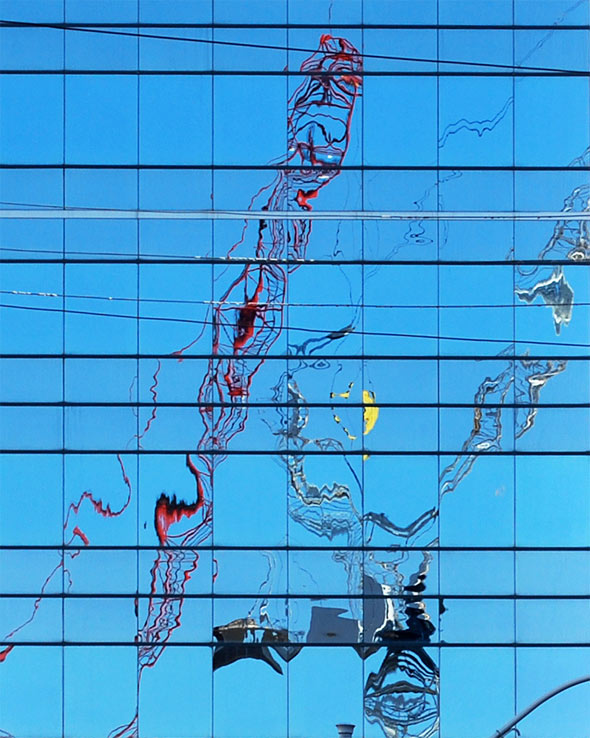
Image: cityscape from Wong Kar Wai's beautiful 2046 (2004).

Tuesday, October 28, 2014

ADFF 2014 Articles (or, I really should write things here rather than just linking to the ADFF site, but....)

I was asked once again to contribute to the website for the Abu Dhabi Film Festival (taking place October 23 to November 1), and this year wrote four articles discussing five films.

Margaret Brown, one of my favourite filmmakers (and my buddy since her beautiful debut Be Here to Love Me screened at TIFF a million years ago) has her utterly brilliant documentary The Great Invisible at ADFF. The film also opens in NYC and LA this Friday -- you should see it if you can. My ADFF review here may give you some arguments why. (Like how I did that?!) Or, if I can't persuade you, here's the trailer.

I also contributed articles on:
- Ramin Bahrani's 99 Homes, a film that joins Margaret's in being, in essence, about the American soul and which was my top pick at TIFF this year;
- Theeb, the first ever "Bedouin Western" and another film that also really dazzled me at TIFF;
- and the aesthetic choices fueling two disparate documentaries, The Wanted 18 and Iraqi Odyssey. The former uses stop-motion animation (of cows, no less) and the latter 3D.

It's always a pleasure to write for ADFF as their programming team tends to select many of my top picks that I've seen at Hot Docs or TIFF and they really let me write whatever I want in my reviews of the films; to whit, my review of The Great Invisible has pretty pointed things to say about the oil industry and did I mention that the festival is in Abu Dhabi...? Anyhow, if you are interested in my latest published musings on films, the links above will take you there.

Thursday, October 31, 2013

Jim Jarmusch and the End of the World (article for ADFF site)

Jarmusch's ONLY LOVERS LEFT ALIVE was one of my two favourite films at this year's TIFF. I could sit down and write an entire book on it (if I had the time, clearly) but for now I've at least penned a small review article for the Abu Dhabi festival site, if you are interested. And see the film whenever and wherever you can: it's bloody great.

Tuesday, February 8, 2011

TIFF's 2011 City to City Focus: Buenos Aires, the "city of tango, psychoanalysis and red meat"

After months of having to bite my tongue, I'm finally able to reveal that this year's City to City program at TIFF will feature the films and filmmakers of Buenos Aires, Argentina.

Buenos Aires is a hotbed of filmmaking, with a new generation influenced by the Argentine New Wave of the early 2000s -- filmmakers such as Lucrecia Martel, Lisandro Alonso, Pablo Trapero (whose Crane World is a personal fave) -- but making their Bs As cinema very much their own. We will announce specific titles in August, after what will surely be months of hard decisions ahead of us (and a trip to the BAFICI festival in April.)

Read more in the press release on TIFF's site.

Monday, January 10, 2011

Journal Article Published: Spectacular Paris


Hello loyal readers (reader?)!
This is becoming (so sadly), the only thing I post on this blog, but I wanted to mention that a journal article loooong in fruition* has recently seen the publication light of day.

(*Especially so, if you consider that it grew out of a paper I wrote for a graduate architecture seminar in 2003.)

The article is ponderously titled "Spectacular Paris: Representations of Nostalgia and Desire," and it appears in the journal
Paroles Gelées (vol. 26 no. 1), available online here. It's kind of a favourite piece of mine: a mobilization of theories including Guy Debord's work in Society of the Spectacle to interrogate the (near)coincident opening of the Paris Las Vegas resort and casino and the release of Baz Luhrmann's Moulin Rouge and Jean-Pierre Jeunet's Amélie, all in short succession around the turn of the millennium. Lots of meaty discussion of illusion, false vacations and, naturally, the spectacle. Both films discussed play a big role in chapter 5 of my diss, so it's nice to see some of my ongoing analysis in this vein see the light of day. Sort of a preview of things to come. Soon.

[Image from Moulin Rouge, dir Baz Luhrmann, 2001]

Sunday, October 3, 2010

Twitchfilm.com Interview


During the opening hours of TIFF 2010, I sat down for an interview with Twitchfilm.com's Michael Guillen to discuss the City to City program, the role of personal taste in film festival curation, the emerging scholarly field of urban-cinema studies and some of what makes TIFF such a unique festival. Michael posted our interview on Twitch and on his own blog, The Evening Class, and he made me sound pretty dang coherent. (Also, just by looking at the other features on the website surrounding my interview, you can see how widely Twitch writers cover cinema and media culture: everything from film fests to one of the funniest ad campaigns ever. Have a browse.)

Thanks Michael!

Tuesday, September 21, 2010

TIFF's City to City 2010 focus: Istanbul


So, the blog entry I started right when we announced this year's TIFF City to City focus (way back in August) was never finished: strangely, TIFF kept me too busy.

While the post was supposed to be the big reveal on the focus city - Istanbul - this will instead be a look back at the programme that was, and a brief one at that.

You can read the text Cameron and I authored about our selection online here.

This page has links to all of the films we programmed - 18 in all.

Here is a link to an article reviewing the programme posted at CBC Arts Online, with arts reporter Jessica Wong, and here I am talking up CTC with Toronto Star reporter Ashante Infantry.

I may try to add to this post over time, but for now I just wanted to get the links up for the read-ables that are already out there.

Friday, July 9, 2010

Urbanism + Typography: The Fun Side of City Branding


I'm a tad besotted with the CitID project, which has received some recent coverage via the New Yorker and Fast Company, among other sites. An initiative of design firm Norwegian Ink, CitID invites designers to create logos for their cities that are superior to your run-of-the-mill, dry, tidy and often completely uninventive tourism efforts. (Torontonians may recall the hub-bub around the uncanny similarities between the Toronto Unlimited campaign and the Bahamas tourism design.)

Not everything submitted to the site will make your socks go up and down, but when designers get it right, the results are lovely. On the one hand, CitID represents a sound argument for more user-generated logo creation, an opportunity that too many organizations and companies deny themselves. On the other, it offers a breath of fresh air to those of us who spend too much time amid theory about how corporate branding is turning our urban surrounds into soulless, interchangeable yawnscapes. Maybe we only need to look out the window to learn that, actually.

In any event, as of today, there is still ZERO representation of any Canadian cities, so Canuck graphic designers, you know what you have to do. Toronto, Montreal, Sudbury, Halifax, Vancouver, Regina... none of these places is going to logo-ize themselves... at least not well.

(Both images courtesy of CitID.)

Tuesday, March 9, 2010

And Another Overdue Mention...


Last spring, I co-edited an anthology on the cinematic representation of my hometown (and current home) with the inimitable Steve Gravestock, TIFF's Associate Director of Canadian Programming.

Tor
onto on Film was published by TIFF and distributed by Wilfrid Laurier University Press (by Indiana University Press outside of Canada). Click here for a link to the WLUP site.

You can read a review of the anthology in the Spring 2010 volume of Cineaste.

It was my first scholarly editing stab, both trial by fire and incredibly rewarding. The collection features essays by critic Geoff Pevere and scholars including Brenda Longfellow, Wyndham Wise and Justin D. Edwards, as well as contributions by TIFF's in-house experts Steve Gravestock, Piers Handling and Matthew Hays, tracing the evolution of the industry here, the eventual obsession with/necessity for role-playing as other cities (license-plating, as Geoffrey Nowell-Smith once referred to it) and, as of late, it's return to some semblance of... itself.

Tuesday, January 5, 2010

Overdue Mention...


Back in the summer, a chapter of mine - first ever to be published - finally saw the light of day after a many-year wait and valiant efforts by the editors to see the project to completion. The anthology is called Moving Pictures/Stopping Places: Hotels and Motels on Film, and was published in July of last year by Lexington Books.


My chapter, written concurrently with the formative stages of my dissertation work, is ponderously titled "Just an Anonymous Room: Cinematic Hotels and Motels as Mnemonic Purgatories." (Honestly... what was I thinking?) The approach is reflective of my (then less-developed) fascination with the intersection of space/spatialization and narrative in filmmaking, analyzing such spaces as "paradigmatic zones of transit and homelessness." I look at Leaving Las Vegas, Memento, The Business of Strangers, Tape, Century Hotel, Chelsea Walls, The Tesseract, Dirty Pretty Things and 2046 and deconstruct the functions of the hotel/motel space in support of the narratives' creation of purgatorial spaces.

Mercifully, I think the chapter held up over the years and the anthology overall contains some great, vigorous analytical writing.

The book is available on Amazon and other online sellers, and hopefully at many local and campus libraries.

Tuesday, June 9, 2009

Forget Urbanism....


... I want to run away and live here... a planned "luxury house" in Kokopo, Papua New Ginea. Wow.
(Be sure to click through all the images.)

Photo via World Architecture News.

Tuesday, May 26, 2009

Bikeopolis: Eat more cake, ride more bike.


It's Bike Month in Toronto. First, here's a quick link to an article on Torontoist about the city's first-ever bicycle parking station, which opens today. Considered in relation to yesterday's heated council debates over more Toronto bike lanes (or, as the plan's gas-loving detractors put it, the city's "war on cars"), we find citizens of TO to be pretty preoccupied with bicyc-ular issues this week. And that is certainly a good thing!

And speaking of bicycles and good things, today is the start of the 2009 Tour de Dufflet.... Pastry-loving pedal-pushers can cycle to any of the three Dufflet pastry locations (787 Queen St. W., 2638 Yonge St., or 1917 Queen. St. E.) to register for the "Tour." They then then must hit the other two Dufflet locations to have their passport stamped, all on the same day. They will be rewarded with treats at every location, and be entered in a grand prize draw. (Admittedly, I'm not sure what the grand prize is, but even if it's a Dufflet cupcake, it'd be good to win.) The tour goes until June 25.

Lastly, if this post inspires anyone to cycle it up in TO, here is a link to the city's various maps showing trails, bike lanes, etc.

Thursday, May 14, 2009

Stop, Collaborate and Blossom?


Just a quick peek at some street-art interventions by American artist Mark Jenkins: plain ol' urban street signs turned into flowers. Yes, sometimes it's just that simple.

On the more conceptual side, Jenkins was also responsible for "The Last Graffiti Artist" which builds a little murder mystery into the the act of painting a gorgeous street mural.

Saturday, May 9, 2009

Excision - The Anti-Photographic Art of Richard Galpin

Just made an amazing find via Life Without Buildings: artist Richard Galpin destroys photographs in a way that is not only beautiful, but also shockingly revealing about both the geometric chaos of the urban scene and the inextricable two-dimensionality of the photographic medium.


Galpin takes a scalpel to a large-scale photograph of a (typically) urban scene, excising clutter and exposing the fundamental geometric configurations that lie in the abstracted plane. In essence, he takes a two-dimensional representation of an urban space and somehow makes it even more two-dimensional, reducing it to an assemblage of shapes without even the impression of dimension, other than that which is to be suggested by the angular configurations that function in the same spatial/representational manner as an M.C. Escher rendering.

Click here for a time-lapse video (no sound, BYOSoundtrack) of his painstaking working method.

So, a question: in "tidying up" the landscapes in this manner, or distilling them down to component patterns, Galpin simultaneously makes them more orderly but also more disorienting. What might that suggest for our relationship to order, or simplicity, versus depth and detail when it comes to the urban landscape?

(Image: "Cluster XXX Angelosopolis" via http://www.richardgalpin.co.uk/)

Sunday, March 8, 2009

I'm Reading....

Tel Aviv: Mythography of a City by Maoz Azaryahu (2007, Syracuse University Press). I can't really tell you why... yet. I'll tell you how it is as I go, however.

What are you reading?

Buildings as Distorted Mirror...


... of their own assembly.

(Twisted, Machiavellian laugh inserted here.)


Image "Cranes Deconstructed" by Ned Lyttleton, via, BlogTO.

Friday, March 6, 2009

Tuesday, February 3, 2009

As usual, behind and thieving...

LOTS going on, so this blog has been malnourished.

A little aesthetic inspiration has come my way from Wordle, via BLDGBLOG. Here, for your (possible) aesthetic enjoyment, is a Wordle word cloud rendering of this very blog...


I've not had much experience with tagging, tag clouds, etc., but a tool this gorgeous offers a fascinating re-visioning of intellectual obsession. Funny thing though: while "city" is, aptly, the most prominent word in my writing and thus, by extension, the largest in the cloud, I've been hunting but still don't see "exorbitant" here anywhere....

As an aside, I'm also playing around with running specific chapters of the dissertation through the Wordle machine... looking forward to seeing how the clusters line up...

Friday, December 5, 2008

Update: Tokyo... and Jenga Towers?

From the good news column: I recently learned that my proposal to the 2009 Society for Cinema and Media Studies conference was successful. I now have until late May to figure out how to fund a trip to Tokyo (!) and to complete my paper on new narratives of gentrification in three recent city films... more "in this space" on that front in coming months....

Also, here's a quick optical riddle: Can anyone else look at this building and not see a giant game of Jenga?


Perhaps that is what the architects of this São Paulo office tower intends when they claim that "the terraces that strongly characterize the towers are nothing beyond a simple game of displacements..."? In any event, an interesting instance of the gaming of the urban landscape... hopefully one that captures a sense of new experimentation with form but leaves off the structural integrity aspect of a Jenga game...

(article and image of Top Towers via WorldArchitectureNews.com.)

Saturday, November 29, 2008

City Symphony: Joris Ivens's Rain

In my dissertation's introductory chapter, I devote some space to discussing the historical backdrop of city symphonies, those glorious early avant-garde works of cinematic documentation and manipulation that forever tied city and cinema together in our imagination. The best-known among them include Manhatta (Strand, 1921), Twenty-Four Dollar Island (Flaherty, 1926), Berlin, Symphony of a City (Ruttmann, 1927), Man With a Movie Camera (Vertov, 1929) and Berlin - Alexanderplatz (Jutzi, 1931), all of which are mainstays of film studies coursework, variably discussed in classes on European, documentary or avant-garde cinema. The term city symphony, borrowed from the subtitle of Walter Ruttman’s abovementioned film about Berlin, has been “applied to numerous films within which practices of visual kinaesthesia constructed a 'symphony' based on the diurnal cycle of life in the modern metropolis, while simultaneously infusing avant-gardist perspectives with a historically and politically cognizant form of social criticism.” (Keith Beattie, see here.) Visual strategies are developed to capture both the image of the modern-era city, and the rhythm and changing phenomena that define it.

Recently, I watched one of the slighter "symphonies" for the first time, Joris Ivens's Rain (1929). In a brisk twelve minutes, the short film captures the scene in Amsterdam during some inclement weather, producing "a poetic meditation on the transformation of a city by rain." (Internet Archive).

You can download the film from the (truly amazing resource that is the) Internet Archive here. (Downloading is better than streaming, fyi, but the quality is admittedly somewhat wanting in either case.)

Ivens’s film adds a weather-related overlay to several of the usual city symphony tropes: a fascination with the changing spaces of the city, crowds of people, public transit (trolleys being the primary mode of the era), the structures that define the landscape and the unusual ways in which the eye may catch them at play. Oblique or ingenious compositions are employed, silently establishing the key difference between the cinematic view of urban life and that available to the citizen on the street: Rain, like the other city symphonies listed, seeks to rise above, peep at from below, run beside, dissect and even re-mix the visual components of early twentieth-century city scenes to capture their kaleidoscopic vigour and frequent social ironies in startling new ways.


In the image above, Ivens films the raindrops on the surface of the canals as the downpour – which arrives a few minutes into the film, after the city scene is established – grows in intensity. The shot is followed by a sequence of images of pedestrians in a square who are, almost to a soggy one, covered with black umbrellas.


The effect is a visual echo, underscoring the manners in which the urban masses are (well?) equipped to respond to their environment. There is something faintly cosmopolitan, one feels, about the crowd's readiness. City life in 1929 is dynamic but orderly.

In the diss, I make the argument that sound film and the dominance of narrative cinema over the avant-gardist project led to a concentration of urban representations in narrative filmmaking and its familiar genres. While there are always exceptions to be found (particularly in the realm of documentary and, perhaps, increasingly so), the city symphony may be considered a form largely confined to the 1920s (predominantly in Europe) through 1940s and early 50s (more so in the United States and New York in particular). I am hoping to organize a screening programme of some sort to return to these earliest films about the city, to facilitate discussion of the optical and cinematic languages that inform more contemporary city films. How, for instance, might one compare the rain-soaked crowds in Rain with those in the polyglot marketplace of Blade Runner, with their futuristic illuminated umbrellas? What characterizes the city spaces of (a vaguely identified) Shanghai (which actually also comprised images of London, Hong Kong and Dubai) in Code 46 versus those of Man With a Movie Camera or Berlin, Symphony of a City? (My preliminary hunch on this latter question is that the sense of an excessively well-maintained master plan is shared among the films while Code 46 is unique more so for what I elsewhere term “the stamp of corporation” than for the visible advancement of its technology.)

In any event, this is primarily a reminder for any who might be interested in the Internet Archive’s amazing depth as a research treasure trove for mid-afternoon curiosity excursions such as this one. Many of the classic city films mentioned above are available there.

One final aside: Rain is a silent film to which – in the version I watched – a grating soundtrack has been added. I’d recommend watching with the sound off or, if you are amenable to a little re-mixing of one’s own, adding a soundtrack. On a first pass, I went with, in order, DeVotchKa’s “The Winner Is” (from the Little Miss Sunshine soundtrack), a brief interlude in the form of Eels’ “Theme for a Pretty Girl that Makes You Believe God Exists” and Max Richter’s “On the Nature of Daylight.” The effect was somewhat more downtempo than the symphonic/rhythmic emphasis discussed above, but it was gorgeous. My second attempt was even more successful: a perennial favourite, Saint-Saëns’s “Aquarium” from Le Carnaval des Animaux, followed by Carly Commando’s “Everyday” and Mark Mothersbaugh’s “Sparkplug Minuet” (from the Royal Tenenbaums soundtrack). It pretty much edited itself.

Friday, October 31, 2008

Easing Back In...: "cynicism in the face of mile-high towers"

Just to get a ball rolling here again, I wanted to point out some interesting questions raised over at BLDGBLOG in a post from yesterday. Author Geoff Manaugh is prepping for a panel discussion in Chicago next Saturday titled "Offshoring Audacity." The panel will be discussing the use of the developing countries and desert spaces of the East as laborities for the architectural and urban planning experiments of Western designers and builders.

As usual, the BLDGBLOG read is compelling, a quick and provocative sprint that runs from indoor ski slopes to Heidegger in a nanosecond. It sets up the questions to be consideed at the panel: Should we celebrate architectural audacity, especially as it witnesses designs crossing cultural divides and carrying American or European architects to Abu Dhabi? Or, as my borrowed title suggests, adopt a cautious cynicism, if not fear, of titanic endeavours that grow up almost over night? And, what role should regional or national identity play in all of this?

In other words, is it perhaps weird enough that Atlantis was resurrected from myth and built in the Bahamas, without it being rebuilt again pretty much the same, in Dubai?

These are all questions that make appearances in Chapter 5 of my diss, so more on this topic in coming months. For the time being, I'll just end with posting a rendering of one of the forthcoming Dubai projects that BLDGBLOG references: Park Gate, a 4.7 million square foot complex of "six mid-rise towers linked together by soaring vaulted canopies."


As World Architecture News reports, it will be part of a 12-year, $15 billion building project commissioned for Dubai from US firm Adrian Smith + Gordon Gill. Funny thing is, it's the first incredibly futuristic, aggressively audacious building project I've read of in a couple of years that hasn't left me with a queasy, paranoid feeling. It looks like an ambitious future site I would actually like to visit, when compared even with the other projects in the plan, 1 Dubai or 1 Park Avenue, both of which leave me with a (perhaps entirely irrational) feeling of dread and fatalism. There's probably some kind of easy urban-emotion version of an ink-splotch test I should take to get at the root or my architectural anxieties... I should look into that before I get back to work on Ch. 5.