Image: cityscape from Wong Kar Wai's beautiful 2046 (2004).
Showing posts with label urbanism. Show all posts

Sunday, October 3, 2010

Twitchfilm.com Interview


During the opening hours of TIFF 2010, I sat down for an interview with Twitchfilm.com's Michael Guillen to discuss the City to City program, the role of personal taste in film festival curation, the emerging scholarly field of urban-cinema studies and some of what makes TIFF such a unique festival. Michael posted our interview on Twitch and on his own blog, The Evening Class, and he made me sound pretty dang coherent. (Also, just by looking at the other features on the website surrounding my interview, you can see how widely Twitch writers cover cinema and media culture: everything from film fests to one of the funniest ad campaigns ever. Have a browse.)

Thanks Michael!

Tuesday, September 21, 2010

TIFF's City to City 2010 focus: Istanbul


So, the blog entry I started right when we announced this year's TIFF City to City focus (way back in August) was never finished: strangely, TIFF kept me too busy.

While the post was supposed to be the big reveal on the focus city - Istanbul - this will instead be a look back at the programme that was, and a brief one at that.

You can read the text Cameron and I authored about our selection online here.

This page has links to all of the films we programmed - 18 in all.

Here is a link to an article reviewing the programme posted at CBC Arts Online, with arts reporter Jessica Wong, and here I am talking up CTC with Toronto Star reporter Ashante Infantry.

I may try to add to this post over time, but for now I just wanted to get the links up for the read-ables that are already out there.

Friday, July 9, 2010

Urbanism + Typography: The Fun Side of City Branding


I'm a tad besotted with the CitID project, which has received some recent coverage via the New Yorker and Fast Company, among other sites. An initiative of design firm Norwegian Ink, CitID invites designers to create logos for their cities that are superior to your run-of-the-mill, dry, tidy and often completely uninventive tourism efforts. (Torontonians may recall the hub-bub around the uncanny similarities between the Toronto Unlimited campaign and the Bahamas tourism design.)

Not everything submitted to the site will make your socks go up and down, but when designers get it right, the results are lovely. On the one hand, CitID represents a sound argument for more user-generated logo creation, an opportunity that too many organizations and companies deny themselves. On the other, it offers a breath of fresh air to those of us who spend too much time amid theory about how corporate branding is turning our urban surrounds into soulless, interchangeable yawnscapes. Maybe we only need to look out the window to learn that, actually.

In any event, as of today, there is still ZERO representation of any Canadian cities, so Canuck graphic designers, you know what you have to do. Toronto, Montreal, Sudbury, Halifax, Vancouver, Regina... none of these places is going to logo-ize themselves... at least not well.

(Both images courtesy of CitID.)

Tuesday, March 9, 2010

And Another Overdue Mention...


Last spring, I co-edited an anthology on the cinematic representation of my hometown (and current home) with the inimitable Steve Gravestock, TIFF's Associate Director of Canadian Programming.

Tor
onto on Film was published by TIFF and distributed by Wilfrid Laurier University Press (by Indiana University Press outside of Canada). Click here for a link to the WLUP site.

You can read a review of the anthology in the Spring 2010 volume of Cineaste.

It was my first scholarly editing stab, both trial by fire and incredibly rewarding. The collection features essays by critic Geoff Pevere and scholars including Brenda Longfellow, Wyndham Wise and Justin D. Edwards, as well as contributions by TIFF's in-house experts Steve Gravestock, Piers Handling and Matthew Hays, tracing the evolution of the industry here, the eventual obsession with/necessity for role-playing as other cities (license-plating, as Geoffrey Nowell-Smith once referred to it) and, as of late, it's return to some semblance of... itself.

Tuesday, May 26, 2009

Bikeopolis: Eat more cake, ride more bike.


It's Bike Month in Toronto. First, here's a quick link to an article on Torontoist about the city's first-ever bicycle parking station, which opens today. Considered in relation to yesterday's heated council debates over more Toronto bike lanes (or, as the plan's gas-loving detractors put it, the city's "war on cars"), we find citizens of TO to be pretty preoccupied with bicyc-ular issues this week. And that is certainly a good thing!

And speaking of bicycles and good things, today is the start of the 2009 Tour de Dufflet.... Pastry-loving pedal-pushers can cycle to any of the three Dufflet pastry locations (787 Queen St. W., 2638 Yonge St., or 1917 Queen. St. E.) to register for the "Tour." They then then must hit the other two Dufflet locations to have their passport stamped, all on the same day. They will be rewarded with treats at every location, and be entered in a grand prize draw. (Admittedly, I'm not sure what the grand prize is, but even if it's a Dufflet cupcake, it'd be good to win.) The tour goes until June 25.

Lastly, if this post inspires anyone to cycle it up in TO, here is a link to the city's various maps showing trails, bike lanes, etc.

Thursday, May 14, 2009

Stop, Collaborate and Blossom?


Just a quick peek at some street-art interventions by American artist Mark Jenkins: plain ol' urban street signs turned into flowers. Yes, sometimes it's just that simple.

On the more conceptual side, Jenkins was also responsible for "The Last Graffiti Artist" which builds a little murder mystery into the the act of painting a gorgeous street mural.

Saturday, May 9, 2009

Excision - The Anti-Photographic Art of Richard Galpin

Just made an amazing find via Life Without Buildings: artist Richard Galpin destroys photographs in a way that is not only beautiful, but also shockingly revealing about both the geometric chaos of the urban scene and the inextricable two-dimensionality of the photographic medium.


Galpin takes a scalpel to a large-scale photograph of a (typically) urban scene, excising clutter and exposing the fundamental geometric configurations that lie in the abstracted plane. In essence, he takes a two-dimensional representation of an urban space and somehow makes it even more two-dimensional, reducing it to an assemblage of shapes without even the impression of dimension, other than that which is to be suggested by the angular configurations that function in the same spatial/representational manner as an M.C. Escher rendering.

Click here for a time-lapse video (no sound, BYOSoundtrack) of his painstaking working method.

So, a question: in "tidying up" the landscapes in this manner, or distilling them down to component patterns, Galpin simultaneously makes them more orderly but also more disorienting. What might that suggest for our relationship to order, or simplicity, versus depth and detail when it comes to the urban landscape?

(Image: "Cluster XXX Angelosopolis" via http://www.richardgalpin.co.uk/)

Saturday, November 29, 2008

City Symphony: Joris Ivens's Rain

In my dissertation's introductory chapter, I devote some space to discussing the historical backdrop of city symphonies, those glorious early avant-garde works of cinematic documentation and manipulation that forever tied city and cinema together in our imagination. The best-known among them include Manhatta (Strand, 1921), Twenty-Four Dollar Island (Flaherty, 1926), Berlin, Symphony of a City (Ruttmann, 1927), Man With a Movie Camera (Vertov, 1929) and Berlin - Alexanderplatz (Jutzi, 1931), all of which are mainstays of film studies coursework, variably discussed in classes on European, documentary or avant-garde cinema. The term city symphony, borrowed from the subtitle of Walter Ruttman’s abovementioned film about Berlin, has been “applied to numerous films within which practices of visual kinaesthesia constructed a 'symphony' based on the diurnal cycle of life in the modern metropolis, while simultaneously infusing avant-gardist perspectives with a historically and politically cognizant form of social criticism.” (Keith Beattie, see here.) Visual strategies are developed to capture both the image of the modern-era city, and the rhythm and changing phenomena that define it.

Recently, I watched one of the slighter "symphonies" for the first time, Joris Ivens's Rain (1929). In a brisk twelve minutes, the short film captures the scene in Amsterdam during some inclement weather, producing "a poetic meditation on the transformation of a city by rain." (Internet Archive).

You can download the film from the (truly amazing resource that is the) Internet Archive here. (Downloading is better than streaming, fyi, but the quality is admittedly somewhat wanting in either case.)

Ivens’s film adds a weather-related overlay to several of the usual city symphony tropes: a fascination with the changing spaces of the city, crowds of people, public transit (trolleys being the primary mode of the era), the structures that define the landscape and the unusual ways in which the eye may catch them at play. Oblique or ingenious compositions are employed, silently establishing the key difference between the cinematic view of urban life and that available to the citizen on the street: Rain, like the other city symphonies listed, seeks to rise above, peep at from below, run beside, dissect and even re-mix the visual components of early twentieth-century city scenes to capture their kaleidoscopic vigour and frequent social ironies in startling new ways.


In the image above, Ivens films the raindrops on the surface of the canals as the downpour – which arrives a few minutes into the film, after the city scene is established – grows in intensity. The shot is followed by a sequence of images of pedestrians in a square who are, almost to a soggy one, covered with black umbrellas.


The effect is a visual echo, underscoring the manners in which the urban masses are (well?) equipped to respond to their environment. There is something faintly cosmopolitan, one feels, about the crowd's readiness. City life in 1929 is dynamic but orderly.

In the diss, I make the argument that sound film and the dominance of narrative cinema over the avant-gardist project led to a concentration of urban representations in narrative filmmaking and its familiar genres. While there are always exceptions to be found (particularly in the realm of documentary and, perhaps, increasingly so), the city symphony may be considered a form largely confined to the 1920s (predominantly in Europe) through 1940s and early 50s (more so in the United States and New York in particular). I am hoping to organize a screening programme of some sort to return to these earliest films about the city, to facilitate discussion of the optical and cinematic languages that inform more contemporary city films. How, for instance, might one compare the rain-soaked crowds in Rain with those in the polyglot marketplace of Blade Runner, with their futuristic illuminated umbrellas? What characterizes the city spaces of (a vaguely identified) Shanghai (which actually also comprised images of London, Hong Kong and Dubai) in Code 46 versus those of Man With a Movie Camera or Berlin, Symphony of a City? (My preliminary hunch on this latter question is that the sense of an excessively well-maintained master plan is shared among the films while Code 46 is unique more so for what I elsewhere term “the stamp of corporation” than for the visible advancement of its technology.)

In any event, this is primarily a reminder for any who might be interested in the Internet Archive’s amazing depth as a research treasure trove for mid-afternoon curiosity excursions such as this one. Many of the classic city films mentioned above are available there.

One final aside: Rain is a silent film to which – in the version I watched – a grating soundtrack has been added. I’d recommend watching with the sound off or, if you are amenable to a little re-mixing of one’s own, adding a soundtrack. On a first pass, I went with, in order, DeVotchKa’s “The Winner Is” (from the Little Miss Sunshine soundtrack), a brief interlude in the form of Eels’ “Theme for a Pretty Girl that Makes You Believe God Exists” and Max Richter’s “On the Nature of Daylight.” The effect was somewhat more downtempo than the symphonic/rhythmic emphasis discussed above, but it was gorgeous. My second attempt was even more successful: a perennial favourite, Saint-Saëns’s “Aquarium” from Le Carnaval des Animaux, followed by Carly Commando’s “Everyday” and Mark Mothersbaugh’s “Sparkplug Minuet” (from the Royal Tenenbaums soundtrack). It pretty much edited itself.

Friday, October 31, 2008

Easing Back In...: "cynicism in the face of mile-high towers"

Just to get a ball rolling here again, I wanted to point out some interesting questions raised over at BLDGBLOG in a post from yesterday. Author Geoff Manaugh is prepping for a panel discussion in Chicago next Saturday titled "Offshoring Audacity." The panel will be discussing the use of the developing countries and desert spaces of the East as laborities for the architectural and urban planning experiments of Western designers and builders.

As usual, the BLDGBLOG read is compelling, a quick and provocative sprint that runs from indoor ski slopes to Heidegger in a nanosecond. It sets up the questions to be consideed at the panel: Should we celebrate architectural audacity, especially as it witnesses designs crossing cultural divides and carrying American or European architects to Abu Dhabi? Or, as my borrowed title suggests, adopt a cautious cynicism, if not fear, of titanic endeavours that grow up almost over night? And, what role should regional or national identity play in all of this?

In other words, is it perhaps weird enough that Atlantis was resurrected from myth and built in the Bahamas, without it being rebuilt again pretty much the same, in Dubai?

These are all questions that make appearances in Chapter 5 of my diss, so more on this topic in coming months. For the time being, I'll just end with posting a rendering of one of the forthcoming Dubai projects that BLDGBLOG references: Park Gate, a 4.7 million square foot complex of "six mid-rise towers linked together by soaring vaulted canopies."


As World Architecture News reports, it will be part of a 12-year, $15 billion building project commissioned for Dubai from US firm Adrian Smith + Gordon Gill. Funny thing is, it's the first incredibly futuristic, aggressively audacious building project I've read of in a couple of years that hasn't left me with a queasy, paranoid feeling. It looks like an ambitious future site I would actually like to visit, when compared even with the other projects in the plan, 1 Dubai or 1 Park Avenue, both of which leave me with a (perhaps entirely irrational) feeling of dread and fatalism. There's probably some kind of easy urban-emotion version of an ink-splotch test I should take to get at the root or my architectural anxieties... I should look into that before I get back to work on Ch. 5.

Tuesday, February 19, 2008

City View

This is gorgeous. I came across the music of Max Richter today while on my never-ending hunt for music that I can listen to while writing. (Fundamentals: sparse, no lyrics, but not atonal or a-rhythmic, nor overly staccato or martial in tenor... I'm tricky that way... lots of Philip Glass, Eluvium and Arvo Pärt listened to around here.)

Richter is a German-born modernist composer who trained in the UK and Italy. I guess, in truth, I had encountered Richter's music previously, as a few of his songs were part of the soundtrack for Stranger than Fiction, but I can muster no particular memory of their place in the film. His compositions are very "cinematic," I think it could be said. I wonder if this means they work better when NOT placed in the service of film narratives but left to stand on their own, to filter in through my headphones while I try to arrange my disorderly thoughts about films and cities into a persuasive argument. Perhaps, but most likely, Richter's pieces are best served by being wedded with imagery like this:


The images were shot by filmmaker Yulia Mahr, who pointed a camera out Richter's NYC window over five nights while Richter was working on the album "Songs from Before" (2006). The song featured is called "Fragment." Collectively, the unison of image and music is exquisite, and produces impressions lying somewhere between the uncomfortable menace of Wavelength, or the chatty (then menacing) voyeurism of Rear Window, while simultaneously reminding me of the urban nighttime footage from Lawrence Johnston's astonishing recent documentary, Night (which I wrote about here and which I'd encourage you to see no matter where you had to drive or fly to to do so).

In the simplest of assemblages, the short film and the music explore the simultaneous beauty and distanciation of quasi-communal urban living.

You can watch other Richter/Mahr collaborations on youtube and, I imagine, all over the web... if you look.

In my next post: an update on that thing I did the other day, and some other sundry thoughts.

Friday, February 8, 2008

Exorbitant Happiness?

Incredibly, an article in En Route magazine caught my eye tonight (discovered via Where). Yep. En Route, the magazine found on Air Canada airplanes, which I have pulled out of a seat-back pockets countless times, flipped open, discovered the crossword to be already half complete, and then closed with some small measure of disdain and a complete measure of disinterest.

But, now, En Route is writing about cities. The article, "The Happy City," explores initiatives recently undertaken in Bogotá, Mexico City and even Paris to make cities happier by making them more pedestrian- and cyclist-friendly, less asphalt jungle and more urban Riviera, and more prone to positive encounter and intersection. The initiatives include turning motorways into beaches in the summertime... in Paris... who would have thought? The author, Charles Montgomery, has a lovely writing style that interweaves moments of flâneur-like urban description with some fairly strong reference to urban researchers and planners:

"There is a wondrous, stirring power to the Champs-Élysées. The street’s lifeblood pulses along sidewalks that are cumulatively much wider than those famous six lanes of traffic. It exists between paving stones, newsstands and café tables, in the dripping of ice cream cones, in long legs and gusts of wind and in the electric possibility of a thousand simultaneous stolen glances.

"The more time we spend on foot, on bikes or even on public transit, the more we slow down and the more we fuel this kind of social alchemy. Ironically, it may be the crisis of climate change – and the push for carbon austerity – that reinvigorates street life around the world."

It's a very interesting read -- again, from an airline magazine no less -- and dovetails with my dissertation's analysis of the function of intersection in urban narratives. In the films, intersection is calamitous, often fatal. In the brilliantly re-planned Happy City of (really?) the real world, close encounters with urban others is the idealized road to a more content, trusting and trustworthy populous. Whence the disconnect?

Also, for another marvelous late-night read about urban culture, head over to my favourite speculative architecture blog and check out Geoff's post on Cloud City (proposed by Studio Lindfors for a design competition aimed at concepts for a disaster-destroyed NYC). As is often the case when I encounter a seemingly impossible concept city, I find myself convinced that this zeppelin -based urbanism is inspired directly by Invisible Cities, but find myself unable to lay hands on the passage, given that book's uniquely confounding structure. Maybe I'll be able to find it tomorrow.

[image courtesy of Studio Lindfors]

Saturday, January 12, 2008

What I Am Reckoning with Today...


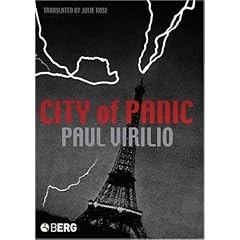
... intellectually, rhetorically and emotionally: Paul Virilio's 2004 treatise (released in an English translation by Julie Rose in 2005), City of Panic. Written in the shadow of 9/11 and the new Gulf war/the war on terror, but also linking brilliantly to the increasing bunkerization of societies (urban and otherwise), the still inadequately understood ramifications of virtual/networked culture, the intermittent urban blackouts of the past decade and even the X Prize (recently considered in a totally different, more positive light here), City of Panic is a typically perspicacious Virilio text, if an atypically bleak one.

The following two passages, among the more dire, sum up the book's urgent primary argument with some concision:

Describing NYC, Baghdad, Jerusalem, Hong Kong but also explicitly all cities: “CITIES OF PANIC that signal, more clearly than all the theories about urban chaos, the fact that the greatest catastrophe of the twentieth century has been the city, the contemporary metropolis of the disasters of Progress.” City of Panic, 90, emphasis in the original

“FORECLOSURE, EXCLUSION… Megalopolitan hyperconcentration is now topped not only with mass hyperterrorism, but also a panicky delinquency that is dragging the human race back to the original dance of death. The city once more becomes a citadel, in other words, a target for all terrors, domestic or strategic.” City of Panic, 95, emphasis in the original

Grim observations but from a prescient thinker on cities, culture, militarism ... and on the militarization of both cities and culture. Once we get past the rhetorical challenges I refer to at the beginning of this post ("megalopolitan hyperconcentration"?), must we de facto accept the challenging conclusions Virilio draws? Are cities doomed, and citizens everywhere along with them?

Sunday, January 6, 2008

Freaking Out Over Freakonomics (and National Treasure Mini-Review)

I finally read the Freakonomics Quorum on "How We Should Be Thinking About Urbanization."

As others have noted, there's a strange aspect to the thinkers/writers represented... some of their points are completely contradictory, yet still manage to sit side-by-side with head-scratching plausibility. Does this mean that the near-term future of cities is really beyond the predictions of even the savviest thinkers in the realms of urban studies? Are we reduced from projects of reasoned argument/prediction to something of a deleterious crap shoot? I'd prefer to hope not, but when one of the most persuasive statements in the batch is the following -- from a celebrated urban planner no less -- it is worrisome:

"No one knows what the next chapter of urban history will bring, but if there is any lesson to draw from what has happened to date, it is that abstract ideas about the proper form of settlement, whether urban or rural or hybrids we can’t yet imagine, tend to lag far behind the reality on the ground." - Robert Bruegmann, professor of art history, architecture and urban planning at the University of Illinois at Chicago

I guess in the end it is here that I like to imagine film serves its social and cultural purpose... When city films are born from a perspective other than that of theory, planning or realism-driven reaction to the state of present cities, but, rather from that of imagining future ones, the cinema may in fact be seen as going where thought with a capital T cannot. I read the varied perspectives in the Quorum, which run, in the words of moderator Stephen J. Dubner, from the apocalyptic to the appreciative, and cannot help but think of the impossible contrasts of Invisible Cities, of that desire to catalog possible futures that can never all sit side-by-each in the unspooling of reality. In Calvino's work, as in the more formidable of the films featured in my study, at least we have a sprawling effort to envision possibilities, diversely wonderful and innumerably horrible. That is the cinema that I love.

In other news, National Treasure: Book of Secrets was precisely what I should have expected: nerve-wracking, cliffhanger after cliffhanger, with occasional dabs of simply lamentable dialogue that has to have been accidentally captured audio of some of the craft-services team making fun of the action: "It's a dead end, we HAVE to go back." Really? Truly? Moments of (I thought) symbolically anti-right-wing plot twists failed to materialize (dumb Kate... it's a Disney movie) and in the end the bad guy (a war profiteer, doncha know) still manages to be redeemed while the President of the USA reveals himself to be a lovable scamp who is game to throw open the history of the White House to some playful historiographic hijinks that will, in the third installment in the franchise, no doubt involve Nicholas Cage and crew unstitching the museum-housed antique petticoats of some former Washington mistress to tease yet another tawdry but lucrative secret out of the American past. There are so many ways in which a film like this could be -- dare I say it? -- smarter, but when kick-ass action sequences and special effects fill seats, well, you know, why bother? Cue the closing sequence fireworks over the compromised silhouette of Mount Rushmore, pass me my copy of The Society of the Spectacle and call it a night, shall we?